Imagine shopping for a daily driver to tow a 7,000-pound travel trailer with the kids, a dog, and family gear along. A full-size SUV, such as a Ford Expedition, Chevrolet Tahoe, or Toyota Sequoia, and a half-ton pickup, such as an F-150, Silverado, or Tundra, may advertise similar maximum tow ratings. Those headline numbers do not show how much payload remains for the people and cargo in your actual vehicle.
An SUV offers enclosed cargo space and passenger seating; a truck offers an open bed. The useful comparison is the exact vehicle's ratings, remaining payload, hitch and trailer compatibility, and how the complete combination is loaded and set up.
Wheelbase and Rear Overhang: Useful, but Not the Whole Story
When a trailer is pushed sideways by a gust or passing traffic, forces travel through the hitch into the tow vehicle. Wheelbase and the distance from the rear axle to the hitch (rear overhang) influence how the vehicle responds. In otherwise comparable setups, a longer wheelbase and shorter overhang can help reduce the leverage the trailer applies around the rear axle.
But these dimensions do not predict the behavior of an entire rig by themselves. Trailer loading and dimensions, tongue weight, tires, suspension, hitch geometry, speed, road conditions, and crosswinds also matter. Compare measured specifications for the exact configurations rather than assuming every SUV is short or every pickup is long.
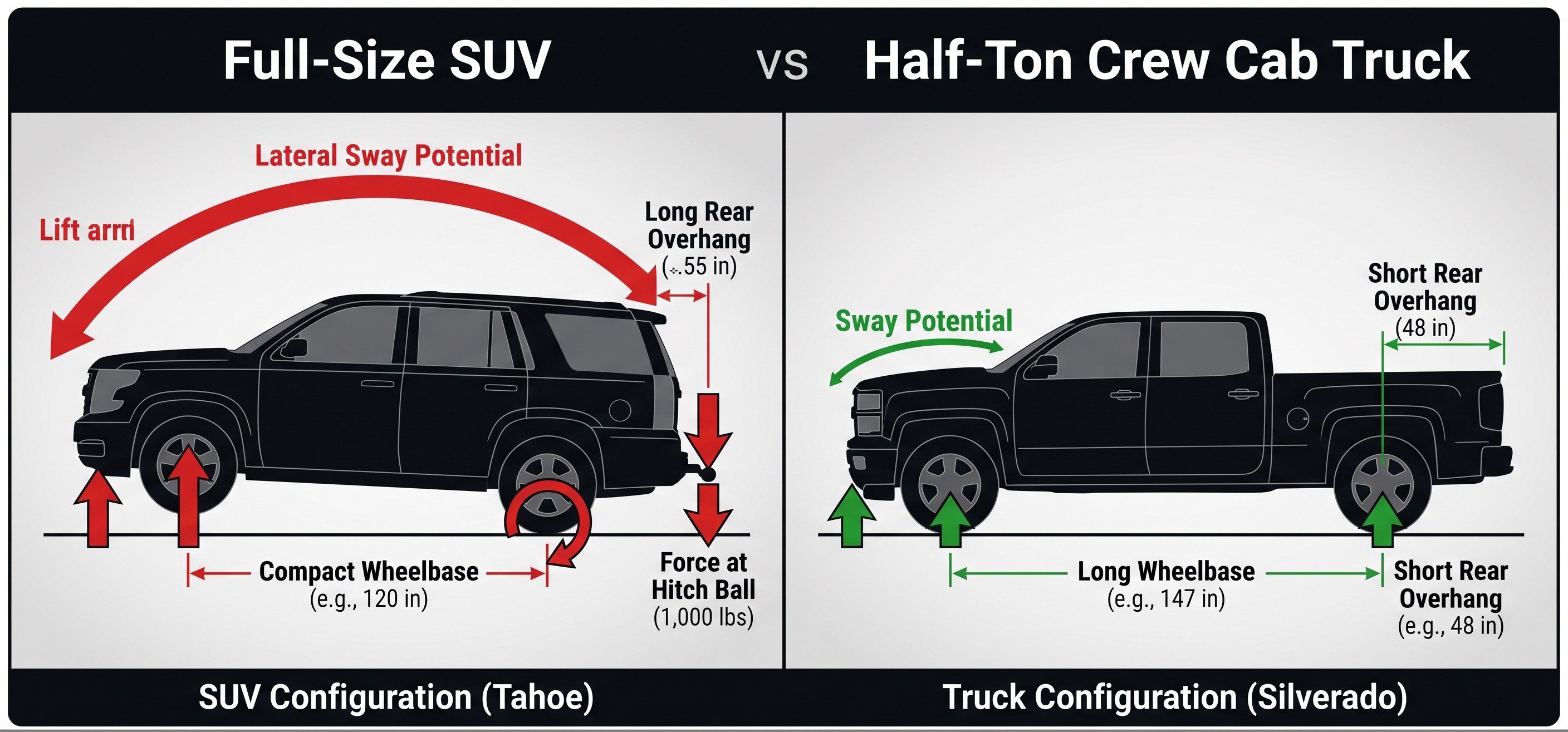
What to compare on your actual setup
- Published wheelbase for the exact vehicle configuration.
- The distance from its rear axle to the hitch ball with the intended receiver and hitch installed.
- The trailer's loaded weight, tongue weight, length, and loading instructions.
- Vehicle and hitch-maker requirements for sway control and weight distribution.
Independent Rear Suspension vs. a Solid Rear Axle
Some SUVs use independent rear suspension (IRS), while many pickups use a solid rear axle. They are different engineering approaches, not a simple “unstable versus stable” ranking. IRS lets each rear wheel move more independently, which can support ride and handling goals. A solid axle links the rear wheels and is common in pickups designed for a wide range of loads.
A correctly engineered and rated vehicle is designed to operate within its stated limits. Suspension type alone does not show how much tongue weight a particular vehicle can carry, whether its wheels will shift under load, or whether it can safely tow a specific trailer. Use the vehicle's payload, axle, tire, receiver, and trailer ratings for those decisions.
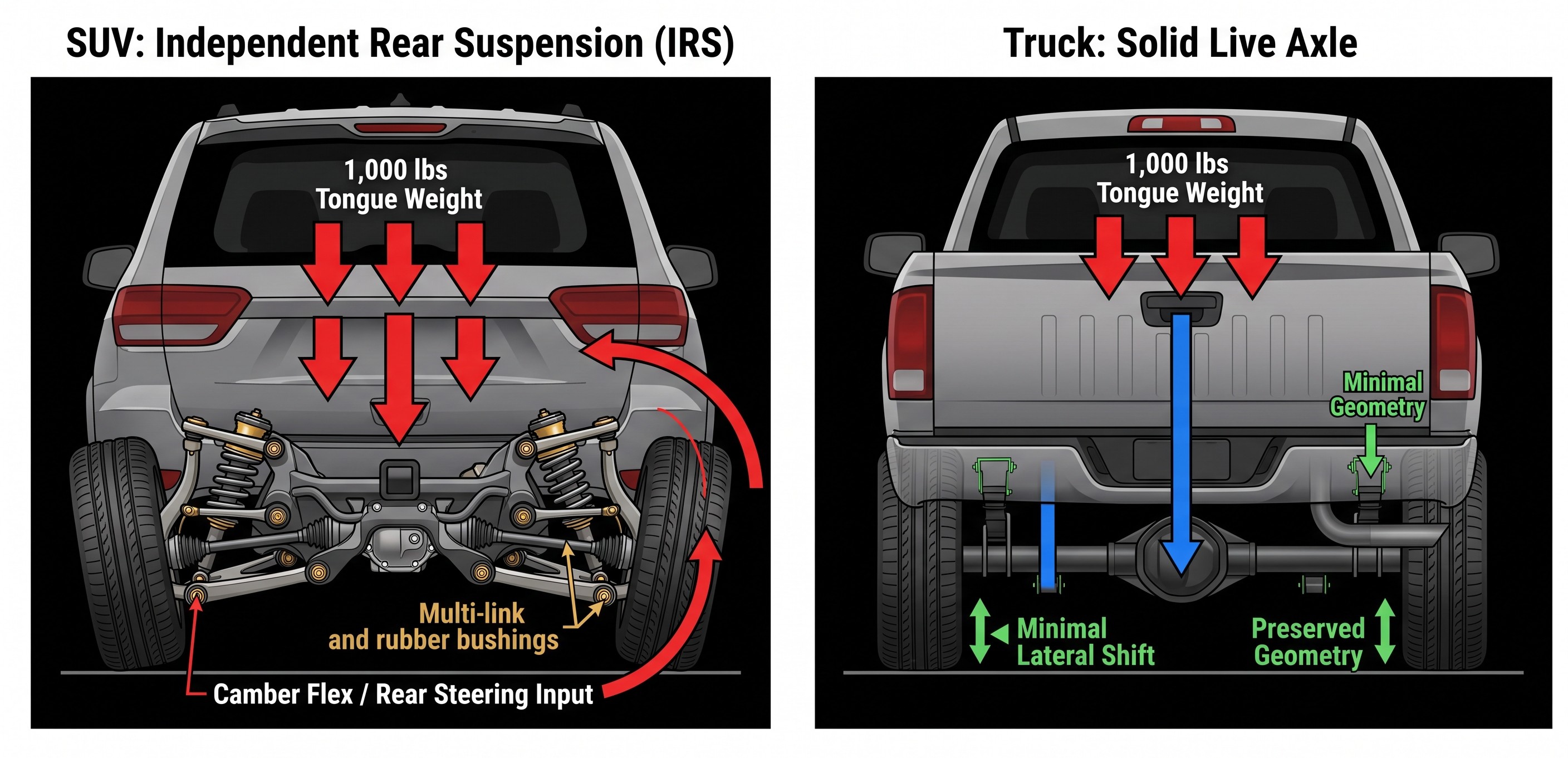
With either design
Follow the manufacturer's loading and hitch instructions. Check tire pressures and inspect the suspension, tires, wheels, and hitch components before a trip.
Don't use add-ons to change the rating
Air springs or helper springs may change how a vehicle sits, but they do not raise its certified GVWR, axle ratings, payload, or receiver limits.
For Family Trips, Payload Can Be the Tightest Limit
Maximum tow rating is only one limit. Passengers, pets, luggage, accessories, hitch hardware, and trailer tongue load all contribute to the load carried by the tow vehicle. A vehicle can be below its advertised trailer rating and still exceed its payload, GVWR, rear GAWR, tire, or hitch limit.
For example, a 7,000-pound loaded trailer with 910 pounds of tongue weight would use 910 pounds of a vehicle's payload. If the vehicle's payload label showed 1,400 pounds, about 490 pounds would remain for the hitch, passengers, pets, and cargo. That is an example, not a claim about every SUV or pickup; the actual label and measured loaded weights determine the result.
The example tongue weight is not a prescribed target. Follow the trailer maker's loading guidance and verify all applicable ratings. A weight-distribution hitch may change axle loads, but it does not increase the vehicle's gross weight or payload rating.
| Example item | Weight |
|---|---|
| Example vehicle payload rating | 1,400 lb |
| Example tongue weight (13% of 7,000 lb) | 910 lb |
| Remaining payload after tongue weight | 490 lb |
Check the tire and loading label on the driver's door for the exact vehicle's occupant-and-cargo limit. Then verify GVWR and front and rear GAWR on the certification label and in the owner's manual.
SUV or Pickup: Which Fits Your Family?
A full-size SUV may fit better when…
- You need enclosed cargo space and flexible passenger seating.
- The specific vehicle has enough payload and axle capacity for your fully loaded family and trailer.
- Its receiver, hitch, tires, and manufacturer towing requirements fit your planned setup.
A half-ton pickup may fit better when…
- You need an open bed for bulky or dirty cargo.
- Its exact payload, axle, and trailer ratings suit your loaded combination.
- Its wheelbase, hitch geometry, and intended use match the trailer and routes you travel.
Neither list is a guarantee. Option packages, passengers, drivetrain, wheelbase, tires, and hitch equipment can change the available capacity substantially—even among vehicles with the same nameplate. Compare the actual door labels, manuals, and hitch ratings before choosing.
A Practical Checklist Before You Tow
Start with the exact vehicle and trailer—not a category-level comparison or a brochure maximum. Work through these checks with the rig loaded as you plan to travel:
Use the exact model year, trim, drivetrain, axle ratio, cab or body configuration, and factory tow package.
Read the vehicle's payload statement on the driver's-door tire and loading label.
Check the owner's manual and certification label for trailer, GVWR, front and rear GAWR, and receiver limits.
Estimate or measure the trailer's loaded weight and tongue weight in travel-ready condition.
Include every passenger, pet, bag, accessory, and hitch component in the vehicle load.
Weigh the loaded combination by axle and compare the results with the ratings for the vehicle, tires, hitch, and trailer.
If the combination exceeds any rating or leaves too little margin for normal loading, reduce the load or choose a different vehicle or trailer. If you are unsure how the hitch should be adjusted, consult the vehicle and hitch instructions or a qualified towing professional.
Official sources and further reading
Keep Researching Your Setup
Review payload and hitch basics before choosing a tow vehicle or configuring a family travel trailer.