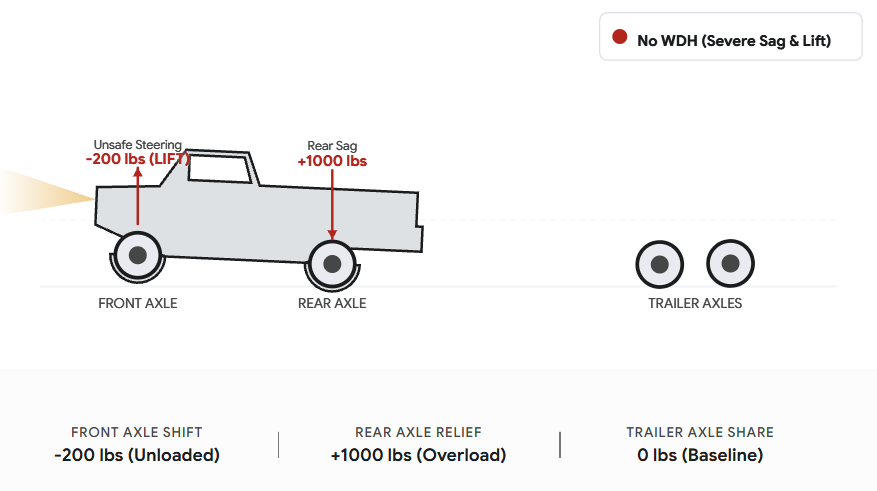
When you drop an 8,000-pound travel trailer onto a standard ball mount, your vehicle acts like a playground seesaw. Because the hitch ball sits several feet behind the rear axle, downward tongue weight forces the rear suspension down while unloading the front tires.
The result is headlights pointing into the treetops, reduced front tire grip, wandering steering, and diminished braking power.
A weight distribution hitch (WDH) does not eliminate tongue weight— gravity cannot be canceled. Instead, it uses mechanical leverage to redistribute downward hitch force across all axles in the setup.
The Physics Problem: The Teeter-Totter Effect
In a standard weight-carrying setup, the truck's rear axle acts as a mechanical fulcrum. Tongue weight applied behind that fulcrum creates a lever that adds more than the tongue's measured weight to the rear axle while removing load from the front axle.
With 1,000 pounds of tongue weight, rear-axle load often increases by 1,200–1,400 pounds because the rear overhang also transfers weight away from the front axle.

With less vertical load on the front tires, the contact patch loses grip. Steering response, crosswind stability, and front-brake traction can all suffer even though the truck may appear capable of pulling the trailer.
Front brakes can provide up to 70% of a vehicle's braking force. When tongue weight unloads the front tires, that lost contact and traction can weaken steering and braking at the same time.
The Mechanical Solution: How Spring Bars Shift Weight
A WDH uses two high-tensile steel spring bars—round bars or square trunnion bars—between the hitch head and the trailer's A-frame. Think of lifting the handles of a loaded wheelbarrow: leverage moves weight toward the front wheel and reduces the load at your hands.
When the spring bars are tensioned and secured:
- The bars resist bending and try to straighten against the trailer frame.
- That tension applies rotational torque to the hitch head and receiver.
- The truck frame is levered downward at the front, restoring front-tire load.
- Part of the hitch load is also transferred through the A-frame to the trailer axles.
Visualizing Axle Load Shift
The diagrams map the rotational forces and axle-load shifts that occur when spring bars are placed under tension.
Real-World Scale Data: The Proof on a CAT Scale
The easiest way to prove weight distribution works is to weigh the truck and trailer on a three-platform CAT scale. Below is an actual weight-ticket scenario for a half-ton pickup towing an 8,000-pound trailer with 1,000 pounds of tongue weight.
| Scale weighing condition | Front steer axle | Rear drive axle | Trailer tandem axles | Total gross weight |
|---|---|---|---|---|
| 1. Unhitched truck only (baseline) | 3,200 lb | 2,600 lb | — | 5,800 lb |
| 2. Hitched, no WDH | 2,850 lb (−350) | 3,950 lb (+1,350) | 7,000 lb | 13,800 lb |
| 3. Hitched with WDH engaged | 3,150 lb (+300 returned) | 3,450 lb (−500 relieved) | 7,200 lb (+200 shifted) | 13,800 lb |
Condition 2: Weight carrying
The 1,000-pound tongue load produces a 1,350-pound rear-axle increase because 350 pounds have been levered off the front axle.
Condition 3: Weight distributed
Spring-bar tension returns 300 pounds to the front, relieves 500 pounds from the rear, and shifts 200 pounds to the trailer axles.
What Is Front Axle Load Restoration?
Front Axle Load Restoration, or FALR, measures how much of the front axle load lifted away by the trailer is returned after the WDH is adjusted. The goal is not simply to make the truck look level.
Most vehicle manufacturers, including Ford, GM, and Ram, specify Front Axle Load Restoration targets between 50% and 100% in their towing guides.
0% FALR
No weight distribution. The front axle remains light and steering feels sloppy.
50% FALR
Recommended by most manufacturers; half of the measured front-end rise is corrected.
100% FALR
The front axle returns to its exact uncoupled baseline weight and fender height.
>100% FALR
Over-restoration can reduce rear-tire traction and overload components.
Manufacturers do not all specify the same target. Follow the tow vehicle's towing guide and the hitch manufacturer's setup procedure rather than assuming 50% or 100% is correct for every rig.
The Tape-Measure Method
If a scale is not immediately available, measure from the ground, through the center of the front wheel hub, to the top of the wheel opening:
- Record the unhitched front-fender height, such as 37.0 inches.
- Couple the trailer without tensioned spring bars and measure again, such as 38.0 inches.
- Tension the bars to the target in the vehicle's instructions. In this example, 37.5 inches represents 50% restoration and 37.0 inches represents 100%.
Never adjust the front fender below its unhitched baseline unless the tow vehicle manufacturer explicitly instructs you to do so.
Essential Weight Distribution and Towing Hardware
Matched WDH and sway control
An integrated sway-control WDH can restore front steering control. Choose spring bars and a hitch head rated for the exact trailer gross weight and measured tongue weight.
Tongue-weight measurement
A built-in hydraulic or mechanical tongue scale measures downforce before you hitch up and helps keep spring bars within their intended operating range.
What a Weight Distribution Hitch Cannot Do
- It does not increase payload: GVWR, GCWR, and axle ratings remain unchanged.
- It does not override receiver limits: stay within both the weight-carrying and weight-distributing ratings stamped on the receiver.
- Airbags are not a substitute: rear air springs can level the body but do not use leverage to restore front-axle load.
If scaled axle weights exceed GAWR or the loaded truck exceeds GVWR after the hitch is correctly adjusted, the trailer is too heavy for that tow vehicle in its current configuration.
Official sources and further reading
Continue Your Towing Research
Review the weight terms used in this guide and learn how payload can become the limiting factor before advertised towing capacity.