A weight distribution hitch can help manage the load from a travel trailer by applying spring-bar leverage between the tow vehicle and trailer. Once you know a weight distribution hitch is appropriate for your vehicle and trailer, you may need to choose between round bars and trunnion bars.
Both designs can be effective when the complete hitch system is correctly matched and installed. Their main differences are how the bars connect to the hitch head, how much room they leave around the coupler and trailer frame, and the clearance of the particular assembly.
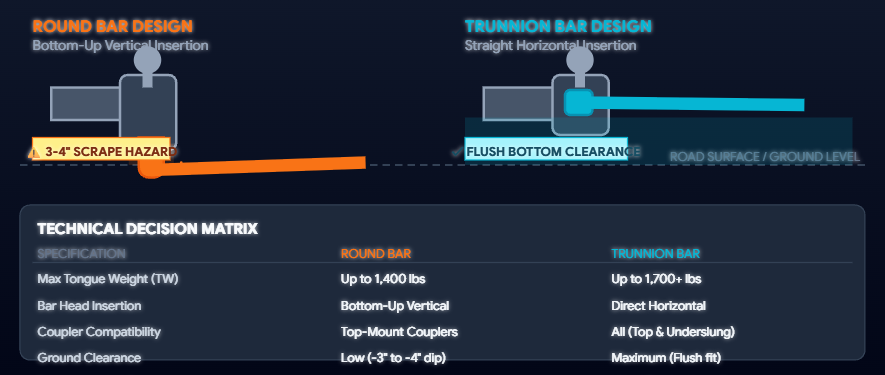
Round Bar vs. Trunnion: Visual Comparison
This illustration compares common bar insertion directions and profiles. It is a general comparison, not a dimensional drawing for every hitch model; actual clearances and ratings vary.
The Main Differences at a Glance
| Feature | Round Bar | Trunnion Bar |
|---|---|---|
| Bar connection | Curved bar inserts upward into the underside of the hitch head | Pivot pins insert horizontally into the hitch head |
| Ground clearance | Some models extend about 2–4 in below the head; check installed clearance | Often more compact below the head; check the complete hitch |
| Coupler fit | Check bar angle and frame clearance for the exact trailer | Can offer more room around some underslung couplers |
| Capacity | Some product lines list up to 14,000 lb GTW / 1,400 lb TW | Some heavy-duty lines list 16,000–17,000+ lb GTW / 1,700+ lb TW |
| Typical bar installation | Insert from below, rotate into position, then attach to brackets | Slide into the head from the side, then attach to brackets |
| Price | Often less expensive, but compare complete kits | Often costs more; compare included sway-control features |
The clearance and capacity figures are examples from product ranges, not limits for every round-bar or trunnion design. Check the current label and instructions for the exact hitch model.
How the Bars Attach to the Hitch Head
Round-bar design
A round spring bar typically has a bent end that fits into a socket beneath the hitch head. The bar is inserted from below and rotated into its working position according to that hitch's instructions. The bend and socket can make the head assembly extend lower than some trunnion designs.
Trunnion-bar design
A trunnion bar uses pivot pins at its head end, which fit into matching openings in the hitch head. On many models, the bar slides in from the side or front rather than upward from below. The shape can provide a more compact underside, though the full installed hitch still needs to be checked for clearance.
Ground Clearance: Measure the Installed Hitch
The bar attachment can affect the lowest point of the hitch. A downward-facing bend may be a concern on a low-riding SUV or trailer, while a trunnion model may leave more space below the head. But ground clearance depends on the hitch model, shank, ball height, vehicle ride height, trailer setup, and road surface—not just the bar shape.
Measure the low point
With the trailer loaded and hitched level, identify the lowest fixed hitch component.
Consider your route
Steep driveways, speed bumps, uneven campsites, and sharp transitions can expose clearance problems.
Keep the trailer level
Do not choose an unsuitable shank or ball height just to gain clearance; use the hitch maker's fitment guidance.
Coupler Orientation and Trailer-Frame Fit
Travel-trailer couplers may sit above or below the A-frame. That orientation changes the space available for the spring bars and brackets, especially during turns. Some trunnion designs can fit configurations where a particular round-bar head or bar angle does not, but there is no universal rule that one style fits every underslung or top-mounted coupler.
- Identify whether the trailer has a top-mounted or underslung coupler before buying.
- Check the hitch manufacturer's compatibility information for that coupler, frame, brackets, and spring-bar rating.
- Confirm the bars and brackets clear the frame, battery box, propane tanks, and other equipment throughout the turning range specified by the manufacturer.
Capacity: Let the Product Ratings Decide
A bar's cross-section alone does not tell you whether a hitch can safely handle your trailer. Manufacturers sell both designs in different weight ranges, and advertised maximums vary by model and bar set. A chart showing a higher maximum for one style is not a substitute for checking the exact part number.
Compare the complete rating chain
- Use the trailer's loaded gross weight, not only its empty or dry weight.
- Measure or reliably estimate loaded tongue weight in travel-ready condition.
- Stay within the ratings of the spring bars, hitch head, ball, shank, receiver, tow vehicle, and trailer.
- Follow the tow vehicle and hitch manufacturers' rules for whether weight distribution is required and how it should be set.
Choosing bars that are far outside the intended tongue-weight range can compromise how the system behaves. If your measurements are near a component limit, have the setup checked by a qualified towing professional before traveling.
Installation and Everyday Hookup
Both styles require correct coupling, spring-bar engagement, and bracket setup. The steps below describe typical differences only; follow the instructions for your specific hitch and use the supplied safety pins and tools.
Typical round-bar sequence
- Couple and secure the trailer as instructed.
- Use the tongue jack to reduce spring-bar tension if the manual directs.
- Insert each bar into the underside of the head and rotate it into place.
- Attach the bars to the frame brackets and install all retainers.
- Lower the jack and recheck the setup and clearances.
Typical trunnion-bar sequence
- Couple and secure the trailer as instructed.
- Use the tongue jack to reduce spring-bar tension if the manual directs.
- Slide each bar into its matching pivot opening and secure it.
- Attach the bars to the frame brackets and install all retainers.
- Lower the jack and recheck the setup and clearances.
Never place any part of your body under a raised trailer tongue or loaded spring bar. Use the hitch manufacturer's designated lifting points and procedures.
Equipment and Maintenance to Consider
The bar style is only one part of the purchase. Compare the complete kit—including its sway-control method, frame brackets, receiver shank, and replacement parts—rather than shopping by spring-bar shape alone.
Sway-control system
Some kits include integrated friction brackets or other sway-control hardware. Compare the complete system's instructions and ratings.
Receiver and shank fit
Match the shank size, drop or rise, and ratings to the actual receiver and trailer. Verify whether any adapter is approved for weight distribution.
Care and hookup tools
Inspect pins and brackets before trips. Lubricate only the points specified by the hitch maker; grease on a friction-sway surface may defeat its function.
A properly rated tongue-jack support block can reduce the amount of jack travel during hookup, but it must stand on stable ground and support the load required by the jack manufacturer.
Which Style Should You Choose?
A round-bar hitch may suit you if…
- The exact model fits your coupler and trailer frame.
- Its installed clearance works for your tow vehicle and routes.
- Its tongue-weight and trailer-weight ratings fit your loaded setup.
- Its price and features meet your needs.
A trunnion-bar hitch may suit you if…
- A more compact underside would help with your measured clearance.
- The bar and bracket geometry fits your coupler and frame.
- The specific model is rated for your loaded tongue and trailer weights.
- You prefer its insertion and removal method.
If both designs fit and have appropriate ratings, compare the manufacturer's installation steps, sway-control features, service requirements, replacement parts, and total price. A properly matched system matters more than the bar label.
Before You Buy: A Fitment Checklist
Confirm the tow vehicle and receiver permit a weight distribution hitch for your trailer.
Record the loaded trailer weight and tongue weight.
Identify the coupler orientation and measure the available frame space.
Check the complete product ratings and compatibility chart.
Compare installed ground clearance with the trailer level and loaded.
Review the installation, adjustment, maintenance, and sway-control instructions.
Official sources and further reading
Continue Your Towing Research
Learn how weight distribution works and review the other parts of a safe trailer setup before choosing equipment.