Towing with an electric vehicle can feel like a paradox. Electric pickups such as the Rivian R1T, Ford F-150 Lightning, and GMC Hummer EV can deliver strong low-speed torque, smooth acceleration, and fewer gear changes than many conventional powertrains. Equipment and output vary by model year and configuration.
The harder question is how far a particular truck can travel before charging. Towing adds weight and aerodynamic drag, so unladen range estimates may not be a reliable trip plan. The size of the range change depends on the truck, trailer, route, speed, and conditions.
The Low-End Torque Advantage: Effortless Pulling
Smooth pull-away
An electric motor can produce substantial torque from low motor speed, which can make starting with a trailer feel responsive. Actual output depends on the motor, software, battery conditions, traction, and vehicle configuration.
Ratings still set the limits
Acceleration does not tell you whether the truck, receiver, tires, trailer, or brakes are within their limits. Verify trailer weight, payload, tongue weight, axle ratings, and hitch compatibility for the specific model.
Torque is rotational force; energy consumption is about the power required over time. A motor's torque figure by itself does not explain how much battery energy a trip will use. Motor output can also be limited by speed, temperature, battery state of charge, and the truck's control system.
Visualizing the Paradox: Torque Curve vs. Range Loss
The supplied graphic contrasts low-speed torque delivery with the possibility of higher energy use while towing at road speed. It is a conceptual illustration: it does not identify a truck, trailer, test procedure, or source data.
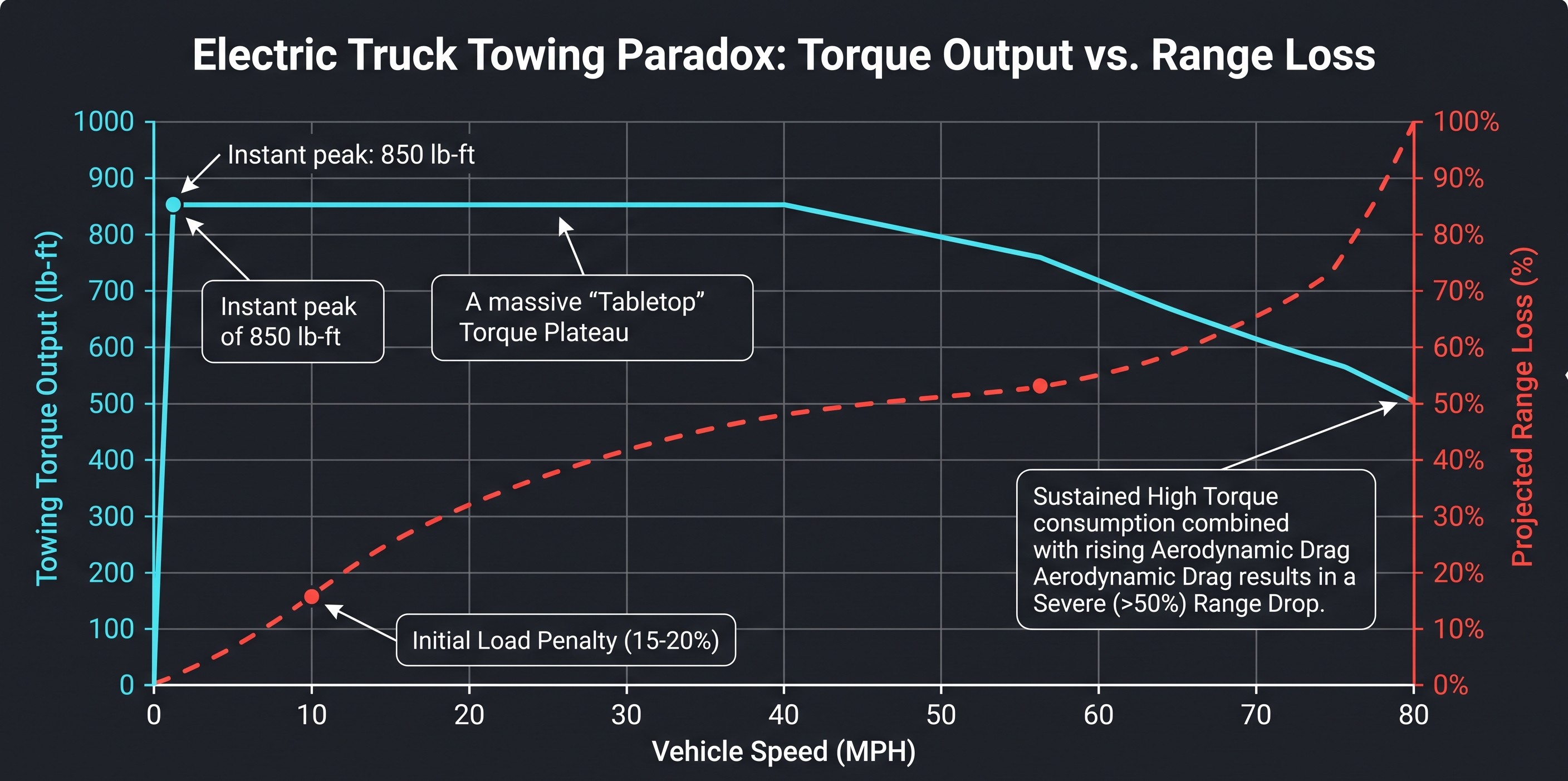
A motor torque curve is normally tied to motor speed, not simply road speed. Likewise, no universal percentage describes how much range a particular truck loses while towing. Use vehicle-specific towing tests or your own energy-use records for a meaningful estimate.
The Downsizing Paradox: High Torque vs. Range Impact
A trailer adds weight and changes the shape of the air moving around the truck. At highway speeds, aerodynamic drag can become a major source of energy demand. Rolling resistance, repeated acceleration, hills, wind, road surface, and accessory use add to it.
Aerodynamic drag rises quickly as speed increases, so reducing speed can improve efficiency in many conditions. The amount of improvement depends on the truck, trailer, traffic, wind, tires, and route. Drive at a safe and legal speed, and do not treat a single speed or range percentage as a guarantee.
Trailer shape
A tall, wide, boxy trailer can create much more aerodynamic drag than a small, low-profile load.
Speed and conditions
Higher road speed, headwinds, cold temperatures, rain, and steep grades can raise energy use.
Load and driving
Trailer weight, tire pressure, acceleration, traffic, and cabin heating or cooling also affect consumption.
Regenerative braking may return some energy during deceleration, but it does not recover all the energy used to climb or accelerate. How much regeneration is available can depend on battery temperature, state of charge, vehicle settings, and the route.
In simplified terms, aerodynamic drag force rises roughly with the square of speed, while the power needed to overcome that drag rises faster. That is why a speed change can make a noticeable difference for some truck-and-trailer combinations; the actual effect depends on the setup and conditions.
Ultimate Tow Vehicle Powertrain Face-Off
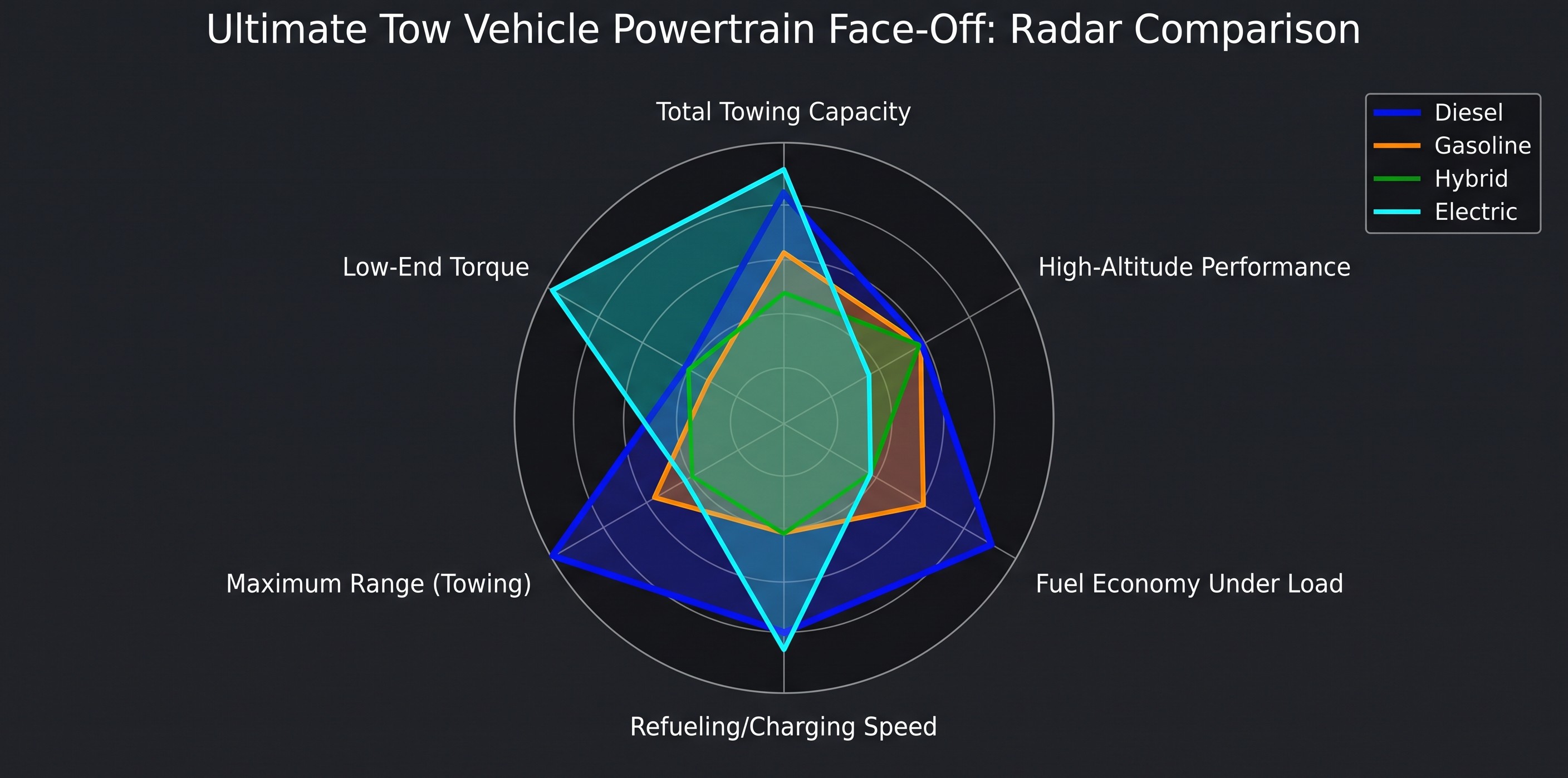
The supplied radar graphic compares broad categories such as torque, range, and refueling or charging speed. It does not provide vehicle models, test results, axis definitions, or a source for its plotted scores. Treat it as a discussion prompt, not a measured ranking of electric, hybrid, gasoline, or diesel trucks.
Trip Planning and Logistics: Adapting to the Reality
A route that is easy in an unladen EV may be less convenient with a trailer. Charging-stall layout, access roads, nearby parking, and whether the site can accommodate a truck and trailer vary. Check station details ahead of time and confirm current availability before relying on a stop.
Some truck-and-trailer combinations can see towing range approach half of their unladen range—for example, a change from 300 miles to about 150 miles. That is an illustration, not a universal result. Use vehicle-specific towing data or your own records for a realistic estimate. Dropping from 70 mph to 62 mph may improve range in some conditions, but choose a safe, legal speed and do not rely on a fixed speed-to-range promise.
Build a trip plan with room for surprises
- Start with energy consumption from towing, not the truck's unladen range estimate.
- Include speed, weather, terrain, trailer profile, and the starting battery charge in each route leg.
- Confirm connectors, charging power, site access, and trailer parking before setting a stop as essential.
- Plan a fallback charger and keep enough reserve to reach it.
Some trips may require disconnecting the trailer to reach a charger or free a stall. Check the site layout, local parking rules, and manufacturer guidance in advance; do not assume every fast charger is trailer-friendly.
Essential Gear for Electric Towing
The truck's trip computer and navigation can help track energy use and plan charging stops. A compatible real-time monitor may also be useful, but a generic OBD-II gauge is not universally essential and may not provide reliable high-voltage battery data. Use equipment supported by your vehicle, and never rely on a third-party reading instead of vehicle warnings.
Record starting and ending battery charge, distance, and displayed energy consumption.
Note the truck, trailer, cargo, tire pressures, weather, route, and approximate road speed.
Repeat only where it is safe and practical; one trip is not a guarantee for a different route or season.
Use the truck's supported navigation and energy information, and follow its towing and charging instructions.
A generic OBD-II gauge is not necessarily able to display reliable high-voltage battery data. Use information supported by the vehicle manufacturer or a compatible, reputable tool, and never rely on a third-party reading instead of vehicle warnings.
Conclusion
An electric pickup can be a strong fit when its exact ratings match the trailer, the route has practical charging options, and the owner is comfortable planning around charging time and energy use. Smooth low-speed response can be appealing for launch and everyday driving.
A different powertrain may suit someone whose towing routes have limited charging access, require long uninterrupted legs, or involve frequent heavy loads. Compare the actual models and trip pattern rather than assuming that one powertrain is always better.
The key trade-off is not simply torque versus range. It is a particular truck's capability, towing energy use, charging or refueling stops, and how those fit the trips you actually take.
An electric truck can offer smooth, responsive towing, but plan around the specific truck, trailer, and route rather than assuming unladen range or a tow rating tells the whole story.
Official sources and further reading
Keep Researching Your Towing Setup
Check payload, trailer setup, and the ratings that apply to your specific vehicle before choosing a tow rig.