On many modern pickups and full-size SUVs, a Tow/Haul button or setting changes how the powertrain responds while towing or hauling. Drivers sometimes treat it as an old-fashioned “overdrive off” switch, expect it to unlock extra horsepower, or worry that higher engine speed will always hurt fuel economy. The feature and its location vary by vehicle.
Tow/Haul does not change engine displacement or create a new mechanical power rating. Depending on the vehicle, it may change shift timing, torque-converter clutch operation, accelerator response, or grade braking. This guide explains those possible changes; the exact calibration and operating instructions are vehicle-specific.
1. Shift Schedule Optimization: Delayed Upshifts & Ending Shift Hunting
In normal driving, transmission calibrations balance efficiency, performance, comfort, and emissions. Under light load, an automatic transmission may select a higher gear; when towing, changing grades or throttle demand can prompt a downshift. Gear-selection strategy differs across transmissions, so one example gear or engine speed does not describe every truck.
Eliminating shift hunting
Shift hunting is repeated upshifting and downshifting as load, grade, speed, or accelerator position changes. Repeated shifts can make towing less smooth and may add heat and wear under some operating conditions, but they do not automatically mean a transmission is being damaged.
How Tow/Haul may help: delayed upshift scheduling
On vehicles designed to do so, Tow/Haul can adjust shift thresholds or hold a gear longer to reduce unnecessary gear searching. Chevrolet's 2026 Trailering Guide and Ford's 2025 Super Duty guide describe this behavior for the models they cover. The mode does not guarantee a particular RPM, torque band, or shift pattern on every vehicle.
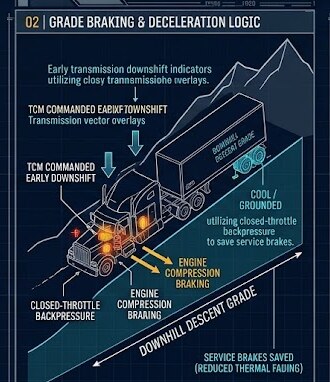
2. Deceleration Logic: Mountain Descent Grade Braking
While an appropriate gear can help control speed on a descent, Tow/Haul's grade-braking behavior—where equipped—is manufacturer- and model-specific. A tow vehicle and trailer carry substantial momentum downhill, and relying on continuous service braking can overheat brakes. Select a safe speed and follow the vehicle and trailer makers' descent instructions.
How grade-braking logic may respond
- The vehicle detects conditions associated with a descent, such as speed, grade, accelerator release, or brake use.
- Depending on the calibration, a brake application or other input may prompt a downshift.
- Engine braking through a lower gear can help manage speed; the exact controls and timing differ by vehicle.
Closed-throttle engine braking
With the throttle closed, engine and transmission resistance can help slow a vehicle in a lower gear. Gasoline and diesel engines, exhaust-brake equipment, and transmission controls behave differently; Tow/Haul does not guarantee a specific braking force or automatically replace service brakes.
Chevrolet's 2026 guide describes grade braking for specified models. Use the instructions for your own vehicle, and keep both tow-vehicle and trailer brakes available and properly maintained.
3. Torque-Converter Lockup Scheduling: A Potential Thermal Factor
A torque converter transfers engine power to an automatic transmission through fluid. Many designs also use a torque converter clutch to reduce slip in some operating conditions. Fluid coupling and clutch operation can contribute to heat, but converter behavior is only one part of a transmission's thermal management.
Some Tow/Haul calibrations may change torque-converter clutch scheduling. They do not guarantee continuous mechanical lockup, zero slip, a fixed gear for lockup, or a particular transmission temperature. Those details depend on the transmission, load, speed, and control strategy.
The supplied cutaway is conceptual. Treat it as an illustration of one possible operating principle, not a measurement or vehicle-specific diagram.
4. Shift Solenoid Line Pressure: What May Change
- Some transmissions alter hydraulic pressure or shift behavior under certain conditions; Tow/Haul does not universally command a fixed line-pressure increase.
- The mode does not guarantee firmer shifts, a specific pressure boost, or less clutch wear on every platform.
- Shift feel can change by design. Consult the owner's manual or a qualified technician if a shift feels abnormal.
5. The Big Question: Does Tow/Haul Mode Save Gas?
The effect on fuel use depends on the vehicle, load, route, speed, and driving style. Tow/Haul may change engine speed, gear selection, and converter operation; those changes can raise or lower fuel consumption in different circumstances. There is no universal MPG penalty or fuel-saving guarantee for empty, light-trailer, or heavy-trailer driving.
Choose the mode for the operating behavior described in the vehicle's manual—not for a promised fuel-economy result. Avoid lugging the engine and follow any manufacturer guidance about transmission temperature, speed, or gear selection.
6. When to Use Tow/Haul Mode (And When to Turn It Off)
Use the operating guide for your make, model, and year. Manufacturers describe when Tow/Haul should be used and whether it is intended for towing, hauling, frequent gear searching, or descents. Do not replace that advice with a universal trailer-weight percentage or a rule that every enclosed trailer requires the mode.
Use it as directed
- If the manual recommends it while towing, use it as directed.
- Before a climb or descent, follow the manual's guidance about Tow/Haul, lower gears, and braking.
- If the transmission keeps searching between gears, the mode may help on vehicles designed for that feature. Get abnormal or persistent behavior checked.
Know when the manual says to turn it off
Some manufacturers caution against using Tow/Haul on slippery roads or in other specific situations. Do not apply that warning to every vehicle, but follow it when it appears in your own instructions. Likewise, do not assume that driving empty or towing a light trailer always requires the mode.
Bottom line
Tow/Haul mode commonly changes shift behavior and may support downhill speed control, but the implementation is vehicle-specific. Check the exact owner's manual, use the mode as directed, and continue to respect the vehicle and trailer ratings.
For more on towing setup, see how axle ratios affect towing and what the Davis Dam gradeability test evaluates.